
Your Q3 referral program launches Monday. The landing page is live, the email sequence is ready, and the sales team is briefed. Someone asks: "What do we send people when they refer someone?" The answer is a Slack message to ops, a spreadsheet of Amazon codes someone bought in bulk three months ago, and a two-week delay that kills the momentum you just built.
That's the version of gift card incentives that doesn't work. Not because incentives don't generate pipeline (they do), but because manual fulfillment at any meaningful volume creates friction that stalls a campaign before it delivers results.
This guide covers how to structure and automate gift card incentive programs across five marketing use cases, with specific benchmarks for each:
- Benchmark amounts for five campaign types — referrals, surveys, webinars, reviews, and demo bookings — with the rationale behind each
- Fixed, tiered, and conditional incentive structures, and when each one fits
- A four-step campaign workflow that runs without manual intervention
- Integration workflows for HubSpot, Salesforce, and Zapier
- A budget model built for finance sign-off
- An ROI model based on cost per action versus customer lifetime value
Why gift card incentives for marketing campaigns works
Gift card incentives for marketing campaigns work because there's a gap between what people intend to do and what they do. An incentive closes that gap by giving people a concrete reason to act now rather than later.
These three reasons explain why gift cards outperform other incentive formats for marketing programs.
Certain beats uncertain
Gift cards have become the dominant incentive format for a reason. According to the Incentive Research Foundation's 2025 Industry Outlook, gift cards account for 43% of all non-cash incentives in North America — more than merchandise and experiential rewards combined. Program discontinuation rates have also dropped from 44% in 2021 to just 15% in 2024.
What this means: organizations running gift card programs are getting consistent enough results to keep them running.
Part of that consistency comes down to certainty. A guaranteed gift card outperforms a sweepstakes entry at the same dollar value. When the reward is fixed — "complete this survey to receive a $25 gift card" — the recipient weighs the effort against a known return. A lottery offers the same expected value on paper but removes that certainty, and for a time-constrained professional, uncertain upside is easy to deprioritize.
Choice raises perceived value
A recipient-choice gift card carries higher perceived value than a fixed-retailer card or a cash equivalent of the same amount. Research published in the Journal of Management Information Systems (2024) found that individuals frequently prefer non-cash incentives over cash, even in for-profit contexts, because the ability to choose is a motivator. A $25 gift card redeemable across a wide range of brands is worth more to the recipient than a $25 single-retailer card (not financially, but psychologically). That difference costs nothing extra to deliver.
In-kind outperforms cash in referral contexts
Paying someone cash to refer a colleague signals a transactional exchange, which introduces social friction — the referrer worries the recommendation will seem self-serving. A gift card carries the same financial value without triggering that dynamic. The referral feels like a benefit rather than a transaction, which is why gift cards consistently outperform direct cash payments in referral program design.
For B2B marketing teams, the practical implication is this: a well-structured gift card incentive program connected to your CRM removes the behavioral barrier for the recipient and the operational burden for your team. A customer deciding whether to complete a 10-minute survey doesn't need a $100 incentive — they need a $25 one that arrives the same day, with no friction between the action and the reward.
The five core use cases
Not every gift card promotion strategy is built the same. What gets a customer to write a G2 review won't get a VP to block 45 minutes for a live webinar. Each use case has its own effort level, its own social dynamic, and its own answer to the amount that moves someone to act.
Here's a closer look at these marketing incentive ideas.
1. Customer referral program rewards
Referral programs fail for two reasons: the incentive is too low to feel worth the awkwardness of making a recommendation, or it's so high it makes the whole thing feel transactional. The $25 gift card benchmark sits in between; it signals that you value the ask without turning your customer into a commissioned sales rep.
Wharton School researchers tracked roughly 10,000 bank customers over six years. It found that referred customers churned 18% less and carried 16% more lifetime value than non-referred customers with similar profiles. That CLV differential is the real case for running a referral program — the $25 gift card is just the trigger that gets it started.
Here's an example: for a B2B team with a $3,000 blended CAC, a referral that closes at twice the rate of cold outbound pays back a $25 incentive many times over. The math works at almost any deal size. And with the right gift card incentive setup, the operational side runs without manual lift once the program is live.
2. Survey and research incentives
The problem with B2B surveys isn't that people don't want to share feedback — it's that a 10-minute survey competes with everything else on their calendar. A $20–$25 gift card doesn't bribe anyone; it just makes the time trade feel fair.
There's a reason the highest-performing incentive programs lean on recipient choice. The IRF 2025 Top Performer Study found that 64% of top-performing companies prioritize perceived value in their gift card programs and 58% emphasize recipient flexibility — both well above what lower-performing programs prioritize. A $25 gift card redeemable across 140,000+ brands and a $25 Amazon card cost the same to send. They don't land the same way.
A product team running a 12-question NPS survey will see higher completion rates with a recipient-choice card than a fixed-retailer one — the financial value is identical, but letting someone choose where to spend it makes the reward feel personal. Timing and delivery structure matter just as much as the amount when running a survey incentive program.
3. Webinar and event attendance
Webinar registration numbers are vanity metrics. Show rates are what matter — and the average across B2B is worse than most marketing teams want to admit. Goldcast's analysis of 19,531 webinars across 418 brands found that only 33% of registrants attend live. Sign up, forget, move on — that's the default. A gift card incentive interrupts that pattern by giving registrants a concrete reason to treat the calendar block as a real commitment.
The benchmark is $25–$50, tiered by who you're inviting. A $25 gift card works for a practitioner audience. For a VP or director being asked to block 45 minutes, $50 better reflects the cost of their time. A demand gen team running a mid-funnel webinar for 200 registrants can offer a $25 gift card to the first 50 live attendees — higher show rate, natural urgency, same incentive value.

4. Review generation (G2, Trustpilot, Google)
A review ask is a three- to five-minute task. The incentive doesn't need to be large — it needs to clear the "is this worth stopping what I'm doing" threshold. For a short, low-friction action, $10 does that reliably.
G2's own platform sets $25 as the default starting value for managed review campaigns, with a stated range of $10–$50 depending on the complexity of the product being reviewed. That range is instructive: $10 is the floor for a brief ask, and higher amounts are reserved for detailed enterprise software assessments that require genuine effort.
For a standard review campaign, start at $10 and let the delivery do the rest — a same-day gift card that lands within hours of an approved review does more for goodwill than a higher amount that arrives a week later.
A SaaS team running a G2 campaign for 100 customers at $10 per approved review has a $1,000 ceiling on a campaign that moves their G2 ranking, arms sales with social proof, and surfaces product feedback — all from a single automated workflow.
5. Lead gen and demo bookings
A $50 gift card for a qualified demo booking is easy to justify when you know what you're paying per lead through other channels. Across B2B industries, the average cost per lead runs from $198 to over $300 for SaaS companies, according to 2025 benchmarks from Martal. A $50 incentive that brings in a pre-qualified, pre-warmed prospect sits well below that — and unlike a cold outbound lead, this one already agreed to show up.
The qualification gate is what keeps it from becoming a gift card giveaway. Without one, you attract anyone who wants $50. A two-question form — company size, current tooling — filters for fit before the calendar invite goes out. The incentive compensates for time; the gate screens for intent. A LinkedIn campaign offering a $50 gift card for a 30-minute demo, gated by company size and budget range, gives a demand gen team pre-qualified pipeline at a cost that competes with any channel in their mix.
Incentive structures: fixed, tiered, and conditional
The structure of an incentive program matters as much as the amount. Pick the wrong one and you either overspend on low-value actions or lose participants before the campaign generates results.
| Structure | How it works | Best for |
|---|---|---|
| Fixed | One amount for one action. Everyone who completes the task gets the same reward. | Reviews, surveys, webinar attendance — low-friction, single-step asks where the action is clear and the value is consistent |
| Tiered | Higher rewards for higher-value actions or sustained participation. The entry point stays low; the ceiling rises for repeat referrers or volume. | Referral programs where you want to reward first-time advocates and ongoing ones |
| Conditional / milestone-based | Rewards fire at multiple points in a funnel rather than only at the final conversion. A referral earns a gift card when the lead books a demo, and another when they close. | B2B referral programs with long sales cycles — keeps advocates engaged across a 3–6 month window instead of making them wait for a closed deal |
Fixed structures are the easiest to operationalize and explain to a recipient. If your use case is a survey or a review, fixed is the right call. Tiered and conditional structures take more setup but perform better for referral programs specifically, where the gap between "someone submitted a name" and "that person became a customer" can be months long. Holding the entire incentive until contract signature loses advocates before they see a return.
For automated delivery across all three structures, Giftogram connects to HubSpot, Salesforce, and Zapier — so whether the trigger is a form submission, a deal stage change, or a webinar check-in, the gift card sends without anyone touching it.
How much to offer: benchmarks by campaign type
The right incentive amount is the lowest one that clears the recipient's "is this worth my time" threshold. That threshold shifts depending on effort, seniority, and what you're asking someone to give up — three minutes versus 45 isn't the same calculation.
| Campaign type | Benchmark | Why it works |
|---|---|---|
| Review (G2, Trustpilot, Google) | $10 | Low effort, low friction. Clears the threshold for a 3–5 minute task without overpaying for it |
| Survey (~10 min) | $20–$25 | Reflects the time cost of a meaningful ask. Choice-based gift cards at this value outperform fixed-retailer cards on perceived value |
| Customer referral | $25 | Meaningful enough to prompt action, low enough to preserve margin at scale |
| Webinar / event attendance | $25–$50 | Requires a time-block commitment. Tier by audience seniority — a director's hour costs more than a practitioner's |
| Demo booking / lead gen | $50 | B2B cost per lead averages $198–$300. A $50 incentive for a pre-qualified demo sits well below any comparable acquisition cost |
All amounts reflect commonly used benchmarks based on Giftogram's gift card platform data. The rationale matters as much as the number — especially when finance asks why the budget looks the way it does.
Campaign workflow: from trigger to delivery
A gift card incentive campaign shouldn't require anyone to manually send anything after the initial setup. The entire sequence — from the moment a qualifying action happens to the moment the recipient gets their gift card — can run automatically.
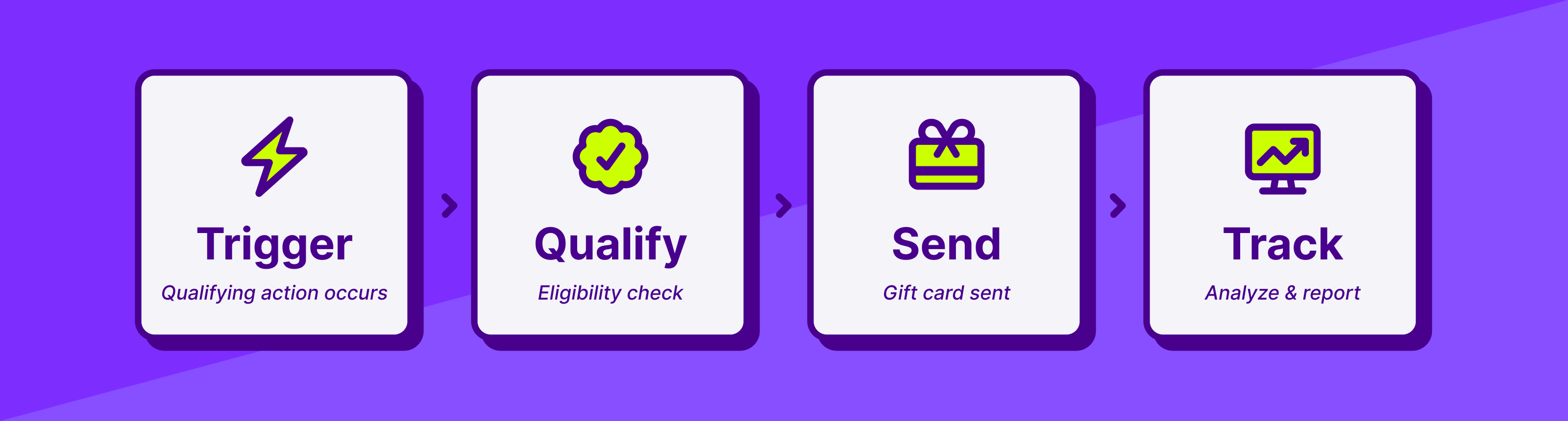
Here's how the four steps connect:
- Trigger. Something happens that qualifies a recipient for an incentive. A survey is submitted in Typeform. A deal moves to "Meeting Scheduled" in HubSpot. A registrant checks into a webinar. The trigger is whatever action your campaign rewards, and it's what starts the sequence.
- Qualify. Before the gift card sends, the workflow checks eligibility. Has this person already received one? Did they meet the minimum criteria — survey completion above a certain threshold, company size above a certain headcount? This step prevents duplicate sends and keeps the campaign budget clean.
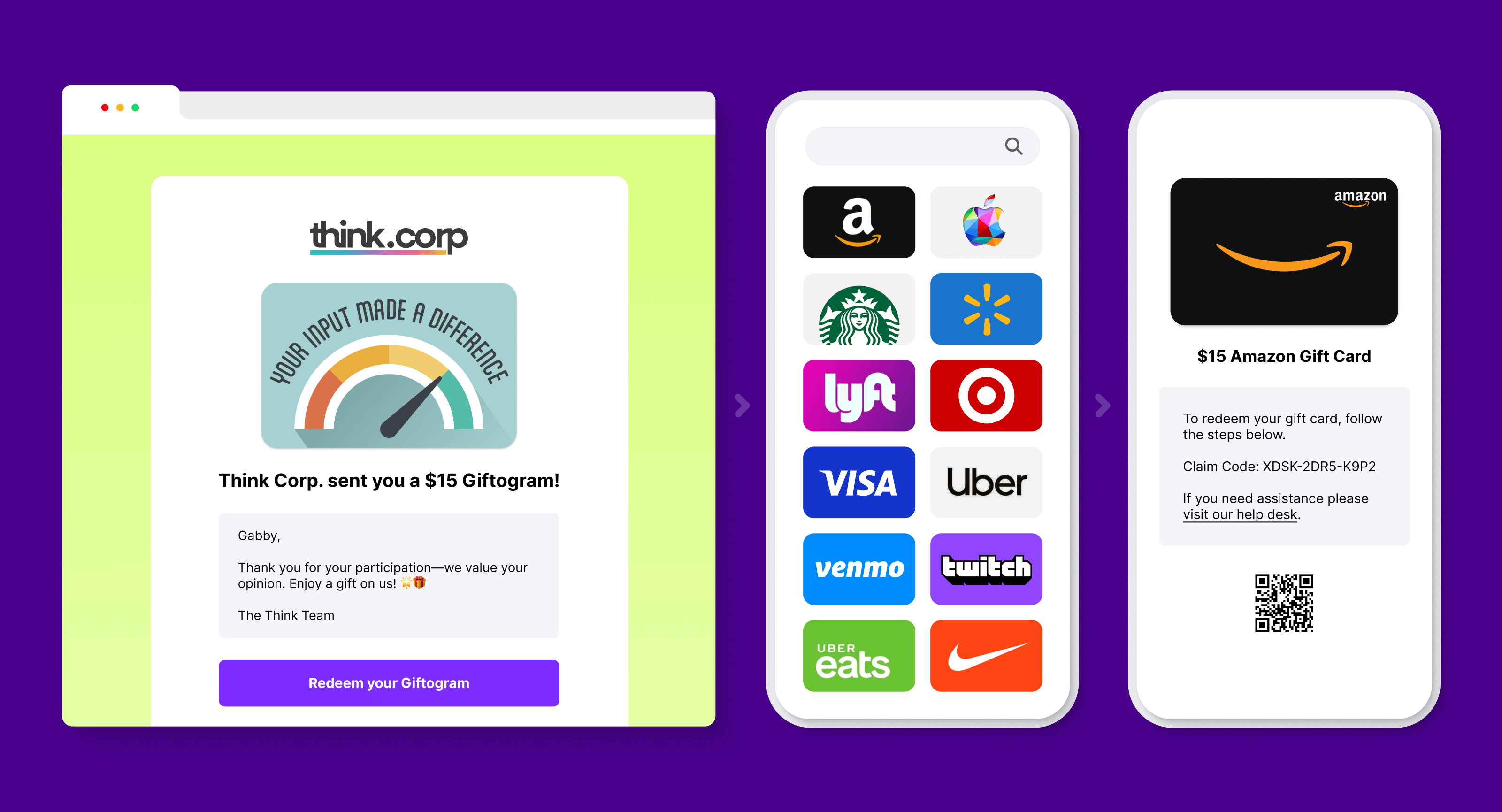
- Send. Giftogram delivers the gift card digitally, same day. The recipient gets an email with their choice from 140,000+ brands — no shipping, voucher codes, or delays. The full incentive value goes to them with no platform fee deducted.
- Track. Every send is logged in Giftogram's reporting dashboard — recipient, amount, date, campaign. Finance gets a clean spend record; the marketing team gets the attribution data to calculate cost per action.
The Zapier integration connects the trigger to the send without any engineering work. A HubSpot deal stage change, a Typeform completion, a Calendly booking — each one can fire a Giftogram send automatically once the Zap is live.
Ready to test a campaign? Create a free account and send your first gift card in minutes.
Integration workflows: HubSpot, Salesforce, and Zapier
Most marketing teams run their first incentive campaign manually: someone exports a list, buys gift cards, and sends them one by one. That works for ten sends. It doesn't work for a hundred. The workflows below connect Giftogram to the tools you already use, so the send happens automatically the moment a qualifying action occurs.
| Platform | Trigger | What fires |
|---|---|---|
| HubSpot | Deal stage change, form submission, contact property update | Giftogram sends to the contact associated with the trigger event |
| Salesforce | Opportunity stage update, lead status change, campaign member status update | Giftogram sends based on any field change that marks the qualifying action |
| Zapier | Typeform completion, Calendly booking, Eventbrite check-in, or any app with a Zapier connector | Giftogram sends based on any Zapier-connected app — no CRM needed. Covers survey completions, webinar check-ins, and demo bookings in a single Zap |
Teams that need to embed gift card delivery directly into their own product or internal tools can use Giftogram's API instead of Zapier.
Budget model: scoping incentive spend before a campaign launches
Incentive budget is a volume calculation. Before going to finance, you need three numbers:
- Expected qualified actions
- Cost per action
- Platform overhead
With Giftogram, platform overhead is zero — the math starts and ends with the incentive amount.
Here's the formula: (expected qualified actions) × (benchmark incentive amount) = campaign cost.
And a few examples of what that looks like in practice:
- Fifty demo bookings at $50 each = $2,500. Two closed deals from that pipeline, at even a modest deal size, covers the campaign cost entirely.
- One hundred survey completions at $25 each = $2,500. Cap the quarterly send volume in the dashboard so the budget doesn't move if response rates exceed what you planned for.
- Two hundred webinar registrants with a $25 gift card for the first fifty live attendees = $1,250 maximum spend, regardless of how many people registered.
Finance will want two things: a spend record and campaign attribution. Giftogram's reporting dashboard exports recipient, amount, date, and campaign in a single pull, making it easier to approve the next budget.
Measuring ROI: cost per action vs. customer lifetime value
The ROI case for gift card incentive programs is straightforward, once you're tracking the right numbers. Cost per action is what you spend to generate a referral, a review, or a demo booking. Customer lifetime value is what that action is ultimately worth. The gap between the two is the return.
For referral programs, the CLV math is particularly strong. Remember, Wharton School researchers found that referred customers churned at 18% lower rates and carried 16% higher lifetime value than non-referred customers over a six-year horizon. So, a customer worth 16% more than your baseline, acquired for $25, is one of the better deals in B2B marketing.
For other use cases, the frame shifts:
- Reviews: cost per review vs. sales cycle acceleration. One G2 review that shortens a prospect's decision timeline pays back a $10 gift card many times over.
- Surveys: cost per insight vs. cost of a research agency or lost product decisions made without customer data.
- Demo bookings: cost per incentivized demo vs. blended CAC. With B2B cost per lead averaging $198–$300 across industries, according to 2025 benchmarks from Martal, a $50 demo incentive that converts at even a modest rate produces pipeline well below any other acquisition channel.
The simplest way to frame it for a finance conversation: what does it cost to acquire a customer through this program, and how does that compare to what you're paying everywhere else?
Run the campaign, skip the manual work
The benchmarks are simple, the workflow is four steps, and the integrations already exist inside the tools your team uses every day. But what holds most incentive programs back isn't strategy — it's the operational drag of buying gift cards manually, chasing down sends, and pulling spend data before a finance meeting.
All you have to do is set the trigger and integrations, and the rest runs without you. Whether you're running referrals, surveys, webinars, or demo campaigns, the delivery side takes care of itself once it's live.
See how Giftogram makes incentive delivery automatic — book a demo.
FAQs
Marketers who know how to send incentives at scale take manual fulfillment out of the process entirely. Connect Giftogram to HubSpot, Salesforce, or Zapier, and the gift card sends automatically the moment a qualifying action fires.
A $25 recipient-choice gift card is the benchmark for most B2B customer referral programs. It's enough to prompt action without making the referral feel like a sales commission — and unlike cash, it doesn't introduce the social friction that makes customers hesitate to recommend you.
Pick the action you want to reward, set an amount that reflects the effort, and automate delivery from the start. A trigger fires, eligibility is checked, the gift card sends same-day, and the spend logs automatically. That's the whole workflow.
Cash and gift cards carry the same face value but don't land the same way. Paying someone cash to refer a colleague signals a transactional exchange — the referrer worries the recommendation will look self-serving. A recipient-choice gift card carries the same financial value without that dynamic, and because the freedom to choose is itself a motivator, a $25 card redeemable across 140,000+ brands consistently outperforms a $25 bank transfer on perceived value.
The default B2B show rate is 33%, meaning two out of three registrants never attend, according to Goldcast's analysis of 19,531 webinars across 418 brands. Offering a $25 gift card to the first 50 live attendees creates urgency without significantly raising the total budget — and for senior audiences like VPs or directors, $50 better reflects the cost of a blocked 45-minute window. Deliver it same-day via an automated check-in trigger, and the reward lands while the goodwill is still fresh.
